
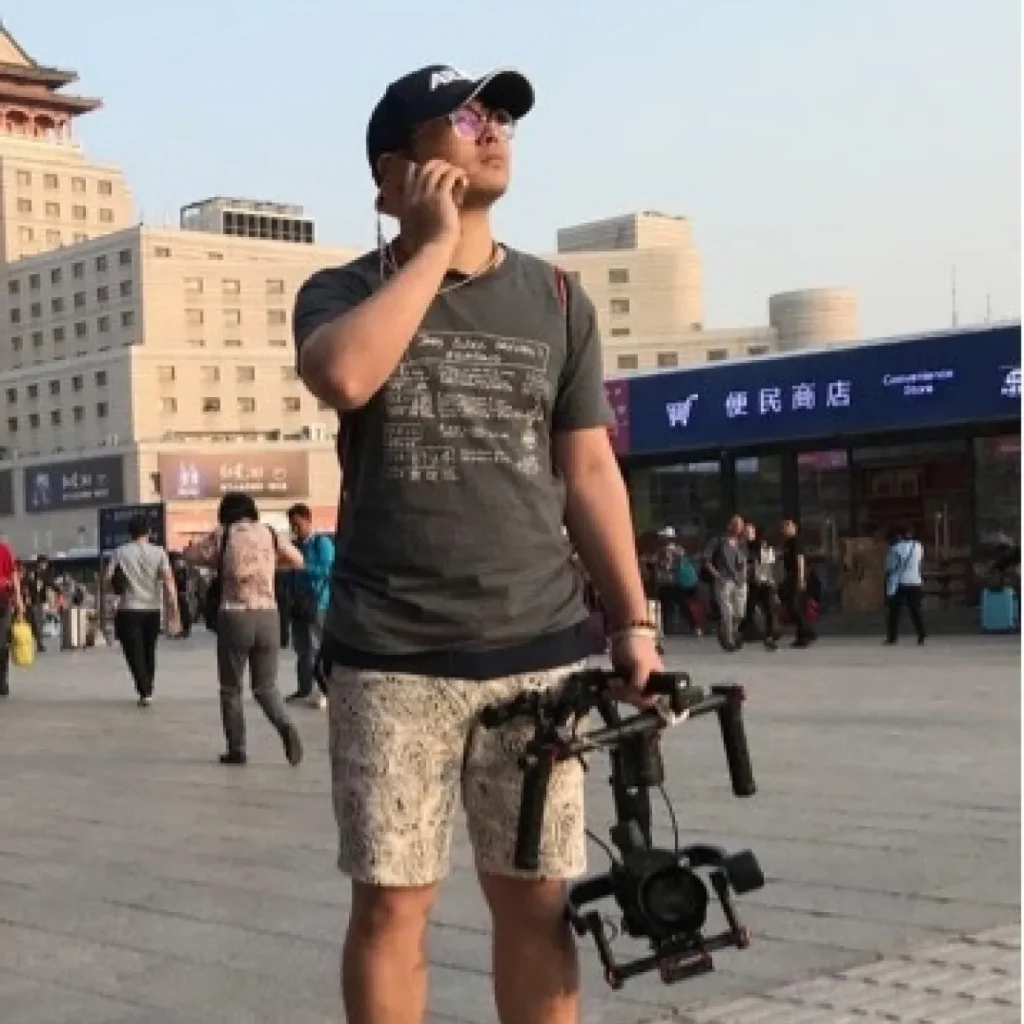
Dr Ruohan Tang is a Senior Lecturer in Immersive and Digital Media at the Winchester School of Art, University of Southampton. He is the Internationalisation Lead for the Art & Media Technology Department. He is also a researcher at the Global Smart Lab, focusing on digital media practices of computing technology with Immersive Media (VR/AR) and Artificial Intelligence. Central to his work are critical & creative methods, interdisciplinary investigations, international collaborations, and a commitment to advancing equality, diversity, and inclusion of media representation and practices.
He teaches in the MA Digital Media Programme, leading the Critical Media Practice Module. He holds professional certificates in Unity for Artists and also a professional certification in Python Programming. With the Faculty International Colleboration Award, he initiates a COIL (Collaborative Online International Learning) project with the Communication University of China, Beijing, on six student collaborative VR/AR projects on the theme of the ‘Inclusive Future’. Two of VR Projects he supervised shortlisted in the Higher Education Competition of the 16th BeijingInternational Film Festival “Boundless ∞ Immersive Section”. The Particle, Particle, directed by Han Liu, supervised by Dr Ruohan Tang (Winchester School of Art) and Prof Jinghan Xu (Communication University of China) has won the Best Interactive Experience Award.
He has been nominated for the Best XR Educator Award of the 2025 Innovate UK Immersive Tech Award. He has received the “Top Viewed Article of 2025” certificate from Wiley’s Journal of Studies in Ethnicity and Nationalism.
His current research investigates how immersive and algorithmic systems shape perception, empathy, and cultural representation. His projects examine how interaction, spatial narrative, hand capture, and sound can sustain empathic engagement and support storytelling in VR documentary and immersive art. He is also engaged in interdisciplinary collaborations with international scholars, exploring how generative systems can be designed to respond more meaningfully to the cultural and situational dimensions of creativity. Drawing on practice-based research, critical theory, and computational experimentation, his work develops creative methods for critically reflecting on questions of access, authorship, and cultural agency within virtual reality and generative AI.